
I’ll be straight with you before you read another word. I have never owned a surfing wetsuit I liked.
I’ve tried them. Borrowed a couple, bought one I regretted. Every one felt like being wrapped in something that didn’t want me to move, and I never found one that felt right in the water no matter what the bloke in the shop said about the cut. I live in Queensland. Most of the year I go in wearing a light rash guard and nothing else, and when the water drops far enough to bother me I go for a mountain bike ride instead, or find someone to have a coffee with.
But a fair few of you are swimming in water that would genuinely hurt you, and you write in asking which bodysurfing wetsuit to buy. So here it is. This is not a review. I can’t tell you what a 4/3 feels like on hour three of a February session in Northern California, because I’ve never done it and I’m not going to pretend otherwise. What I can tell you is what bodysurfing does to a wetsuit that surfing doesn’t, why the fit problem I never solved is the one you’re about to run into, and how to think about thickness. The picks at the end rest on specifications, review weight and other people’s testing, and I’ll say so as we go.
What Bodysurfing Does to a Surfing Wetsuit

A surfer spends most of a session out of the water. Sitting on a board, torso in the air, legs dangling. They go under in bursts, and between waves they drip dry in the wind. That is the difference between riding on a wave and riding in one, and it decides what your suit has to cope with.
You don’t do any of that. You are in the water the entire time, submerged to the neck at best and fully under most of the time, swimming hard and moving constantly. That difference sounds obvious. It changes two things that matter.
Flush is continuous, not occasional. Neoprene doesn’t keep you warm by trapping a layer of water that your body heats up. That’s the version most people were told and it’s mostly wrong. The Appalachian Mountain Club puts it plainly: the insulation comes from the neoprene itself, a closed cell foam full of tiny nitrogen bubbles that slow heat moving out of you. Water getting in is not the mechanism. Water getting in and being replaced is the problem, because every exchange takes your heat with it.
For a surfer, a slightly loose neck seal leaks now and then. For you it flushes all session, every wave, because you’re never out of the water long enough for it to stop. A neck that a surfer would call acceptable will make you cold.
You’re generating heat the whole time. You’re swimming, not sitting. That works in your favour and it means bodysurfers can often go a bit thinner than a surf shop chart suggests for the same water. Not much thinner. But if you’re between two thicknesses and you swim hard, the thinner one is usually the better call.
The third thing is wear. You spend more time in the impact zone getting worked than a surfer sitting out the back does, and sand and shorebreak are harder on seams and knees than open water is.
If you are newer to this than the rest of the article assumes, start with what bodysurfing actually is and come back.
Why a Bodysurfing Wetsuit Never Feels Right, and What to Check
This is the part I can speak to honestly, because I failed at it repeatedly.
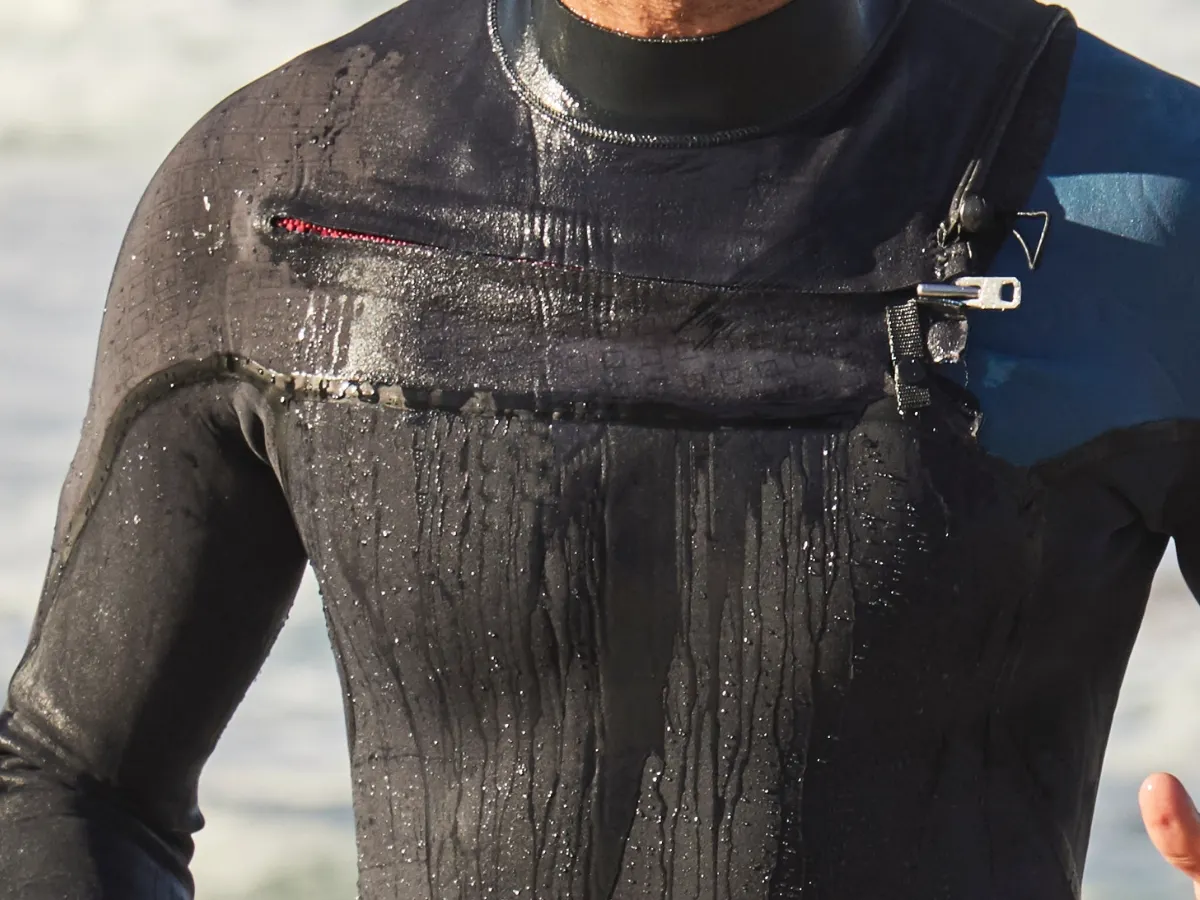
Every wetsuit I tried was restrictive. Not slightly. It felt like the suit had opinions about where my arms should go. Some of that is just what neoprene is, and anyone who tells you a wetsuit disappears once you’re moving is selling something. But a lot of it is fit, and fit is where most wetsuit money gets wasted.
Here’s what actually matters.
A suit that fits in the shop can be wrong in the water. Dry neoprene and wet neoprene behave differently, and a suit that feels merely snug standing in a change room can feel like a chest strap once it’s wet and you’re working. Take it as a given that the shop fit is a rough guide, not an answer.
Torso length beats chest size. This is the one I wish someone had told me twenty years earlier. Most people size a wetsuit by how it fits across the chest and shoulders, then wonder why it pulls at the crotch or bags at the small of the back. If the torso length is wrong, nothing else you adjust will fix it. This is exactly what regular, short and tall sizing exists for, and it’s why brands that offer those fits are worth more than brands that don’t.
Snug, but you must be able to breathe out fully. Here is where I’d rather you took me seriously than took me for a purist. You are going to get held under. That is not a maybe, it’s the sport. A suit tight enough across the chest that you can’t empty your lungs properly is a genuine problem in a hold-down, not a comfort complaint. When you try one on, exhale all the way and then do it again. If the suit fights you, it’s the wrong suit.
No gaps at the neck, wrists and ankles, but no strangling either. Those are the flush points. On a bodysurfer the neck is the one that matters most, for the reason above.
I’ll be honest that buying a wetsuit online is a gamble. You are guessing at a fit that even a change room only half answers. Buy from somewhere with a returns policy you’ve actually read, and try it on dry at home before it goes anywhere near salt water, because a suit that’s been in the ocean is a suit you own.
Surfing Wetsuit Thickness and Water Temperature
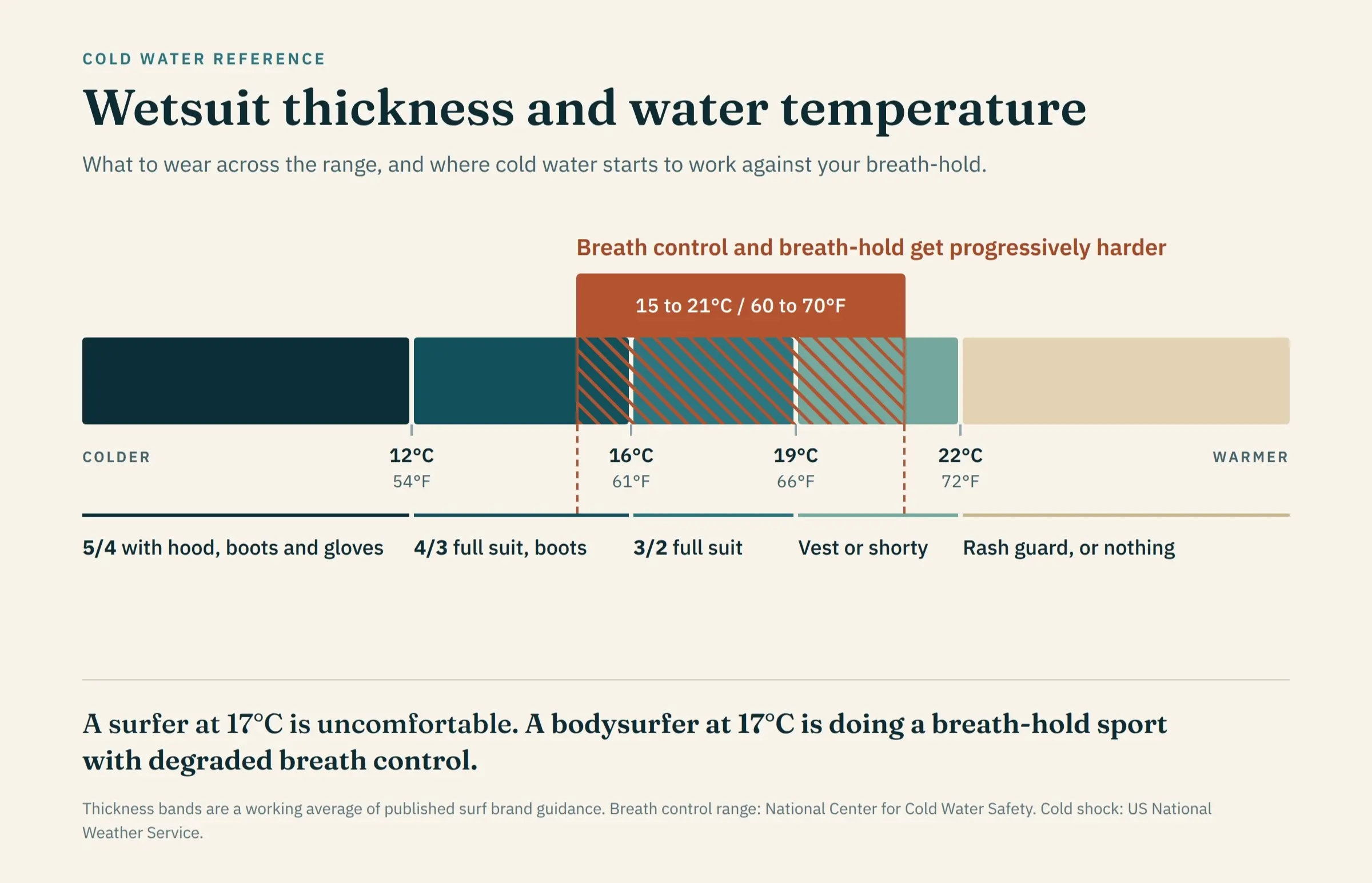
The two numbers on a suit, 3/2 or 4/3 or 5/4, are millimetres of neoprene. The first number is the torso, the second is the arms and legs. Thicker on the body where you lose most of your heat, thinner on the limbs so you can still move them.
Rough working bands, and every brand publishes a slightly different version of this:
| Water | Typical suit |
|---|---|
| Above 22C / 72F | Rash guard, or nothing |
| 19-22C / 66-72F | Vest, top or spring suit |
| 16-19C / 61-66F | 3/2 full suit |
| 12-16C / 54-61F | 4/3 full suit, boots |
| Below 12C / 54F | 5/4 with hood, boots and gloves |
Now the part the surf charts don’t tell you, and the reason I’d suit up earlier than a surfer would.
Cold water’s first effect is on your breathing, not your comfort. The National Center for Cold Water Safety describes water between 15 and 21C, roughly 60 to 70F, as the band where controlling your breathing and holding your breath get progressively harder. The US National Weather Service goes further and notes that gasping and rapid breathing can be triggered by water as warm as 25C, or 77F, and that cold shock from water at 10 to 15C can be as severe as from water near freezing.
Think about what that means for us specifically. Breath holding is not incidental to bodysurfing, it is the whole activity. A surfer at 17C is uncomfortable. A bodysurfer at 17C is doing a breath-hold sport with degraded breath control. That’s a different problem, and it’s why I’d rather see you in a suit a bit sooner than the chart says than a bit later.
None of that is a reason to be frightened of cold water. It’s a reason to respect the number on the forecast rather than the number on the air temperature.
When You’re Better Off in Less Than a Full Suit
Every surf site will happily sell you a full suit, because a full suit costs more. For a bodysurfer, in a lot of conditions, it’s the wrong answer.
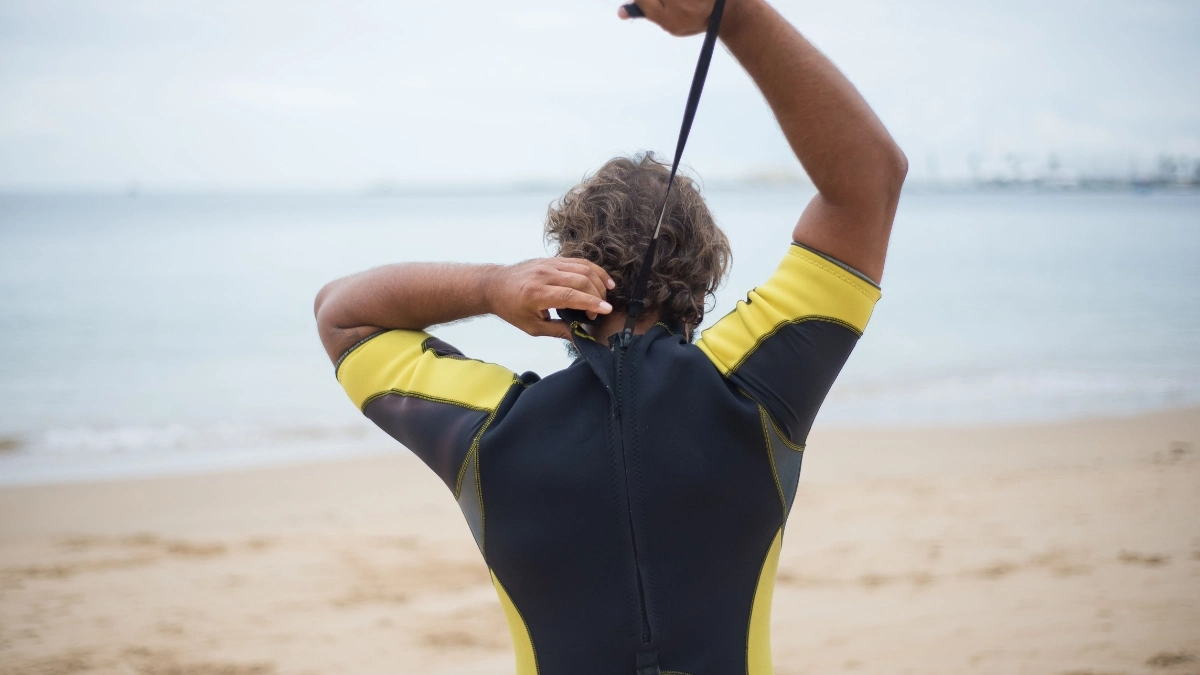
If the water is marginal rather than genuinely cold, a vest or a neoprene top gets warmth over your core, which is where you lose it, without wrapping your arms in anything. You swim with your arms. Anything that restricts them costs you more than it costs a surfer, who mostly uses their arms to paddle in a straight line. A spring suit does much the same with a bit more coverage.
There’s also a cheaper answer, which is that the shoulder flexibility surf brands charge a premium for is mostly wasted on you. Those expensive super stretch panels exist to make paddling easier. You don’t paddle. If you’re choosing between a pricier suit with better shoulder articulation and a plainer one that fits your torso properly, take the fit every time.
And the honest last option: sometimes the water is too cold and the answer is you don’t go in. I ride my bike. There’s no medal for being the coldest bloke at the beach.
The Picks
None of these are suits I’ve worn. Each one is here on specifications, review weight and stock reliability, and I’ve said what each is for rather than ranking them, because the right one depends entirely on your water.
Every link below is an affiliate link. It costs you nothing extra and it keeps this site running.
Marginal water: O’Neill Reactor-2 2mm Pullover Vest
Core warmth, arms completely free. For water sitting just under comfortable, this is the most bodysurfer-shaped thing on the list. Pullover, so there’s no zip to leak or dig in.
Marginal water, more coverage: O’Neill Reactor-2 1.5mm Long Sleeve Top
Same idea with sleeves, in thin neoprene that doesn’t fight your stroke much. Worth knowing this one is listed under clothing rather than water sports on Amazon, which occasionally means sizing runs closer to a rash guard than a wetsuit.
Cool water: O’Neill Reactor-2 2mm Spring Suit
Short sleeves, short legs, back zip. Covers the core and thighs and leaves your arms alone. Sat fourth in Amazon’s shorty wetsuit category as at September 2026, which tells you the fit works for a lot of people.
Cold water: O’Neill Reactor-2 3/2 Full Suit
The default full suit and the one I’d point most people at first. Amazon lists it as an overall pick in the category with around fourteen hundred ratings at 4.4 as at September 2026, and it’s badged as top reviewed for fit, which for a wetsuit is the review that counts. Back zip, which is easier to get into and slightly more prone to flush than a chest zip.
Cold water on a budget: Hevto 3/2 Front Zip
Not a surf brand, and I want to be upfront about that. What it has is sixteen size options including short and tall fits, which addresses the torso length problem better than some suits costing several times more, and a review base in the thousands. If the choice is this or nothing, take this.
Properly cold water: O’Neill Epic 4/3 Full Suit
When you’re into the water where cold shock stops being theoretical. Thicker through the torso, back zip, and a review base around twelve hundred at 4.5 as at September 2026. Pair it with boots.
Frequently Asked Questions
Does a wetsuit keep you dry?
No, and it isn’t trying to. A wetsuit lets water in and relies on the neoprene to slow your heat escaping. The suit that keeps you dry is a drysuit, which is a different and considerably more expensive thing, and not something you’d bodysurf in.
Do wetsuits work by warming a thin layer of water?
Mostly no, though you’ll hear it everywhere. The warmth comes from the closed cell neoprene itself, which is full of gas bubbles that slow heat transfer. The water inside your suit is a side effect rather than the mechanism, which is why a suit that constantly exchanges that water leaves you cold. Keeping water out matters. Heating it is not the plan.
Can you bodysurf in a shorty?
Yes, and for a lot of conditions it’s the better choice. A shorty or spring suit covers your core and thighs and leaves your arms free to swim, which suits bodysurfing better than it suits surfing. Once the water is cold enough that your hands and feet stop working properly, you want the full suit and probably boots.
How thick should a wetsuit be for bodysurfing?
A bodysurfing wetsuit wants roughly the same thickness as for surfing in the same water, and you can often go slightly thinner because you’re swimming and generating heat rather than sitting still. Judge it on the water temperature, not the air, and lean warmer than you think if you’re going to be in a heavy shorebreak where getting held under is likely.
If your water doesn’t need a wetsuit at all, you’re in the happy majority and a rash guard is very likely all you need. That’s what I wear, and there’s a whole piece on picking one.